The Tree Placement Plan
A yard or street tree placed so the grown tree fits: its spread and its height checked against the house, the paving, the power line overhead and the buried lines, a row's shade counted once, a flat planting ring, and the trees already there
TreeUrban's Tree Spacing Calculator fits grown crowns into an empty rectangle by their spread alone, while every published distance from walls, paving and power lines is written by the tree's grown height, which the calculator never asks for. In a 70 by 70 ft back yard with a power line along the back lot line, it fits 1 oak or 4 red maples. Checked against the Arbor Day Foundation's distances, the oak has one possible line, 20 ft from the house, where its grown crown reaches 10 ft over the roof, and none under the line's rule of thumb; the red maples are 2, in one row. (We fixed three of the site's calculators while writing this: whole tree counts, a mulch depth ceiling, and an age page that quoted an accuracy figure with nothing behind it.) The Tree Placement Plan checks a spot the way the rules are written. You stake where the trunk will stand, call 811 and wait for the marks, write each candidate's grown spread and grown height, and let the strictest distance win: wall, corner, paving, the line overhead and the lines below. Then it keeps the crown on your side at half its spread, counts the shade a row really adds (a fourth hornbeam on a 100 ft line adds 449 sq ft, not the 707 sq ft of a whole crown), sizes a flat mulch ring 2 to 4 inches deep with the flare left bare (4 bags where a mound takes 10), and logs the trees already there with an honest range on their age (a red oak the estimator puts at 56 years could be 40 to 112). Every figure is an example computed by code from TreeUrban's own calculators and the distances it quotes, read 2026-10-04 from the Arbor Day Foundation, UVM Extension and Illinois Extension. It recommends no species, makes no claim about roots and foundations, and leaves work near power lines to the utility and pruning, climbing and felling to a certified arborist. Inside: 7 steps, a spot sheet, a candidate fit sheet, a ring and mulch sheet, a tree log, a reference table and a quickstart, plus a personalised sheet worked from the numbers in the calculator you came from.
Look inside
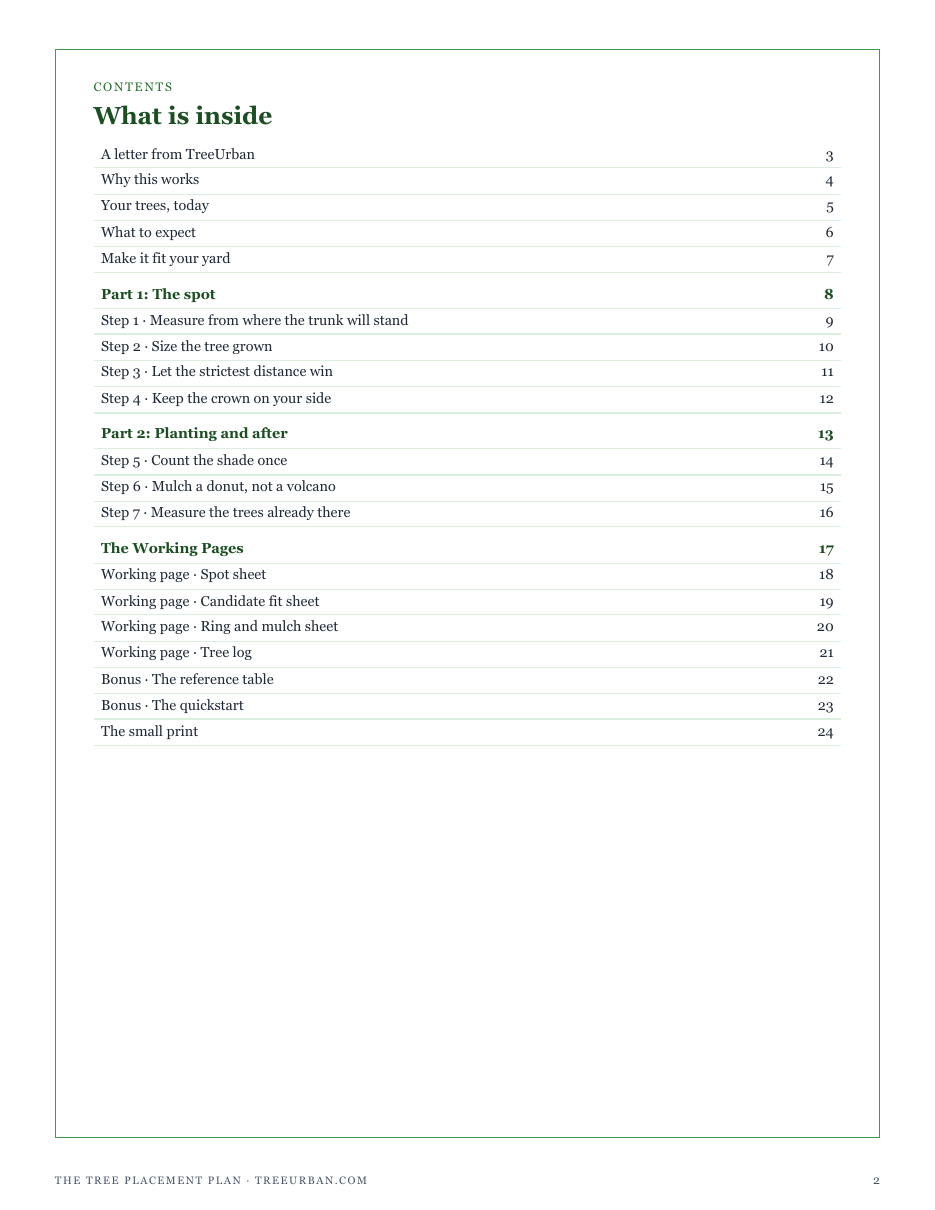
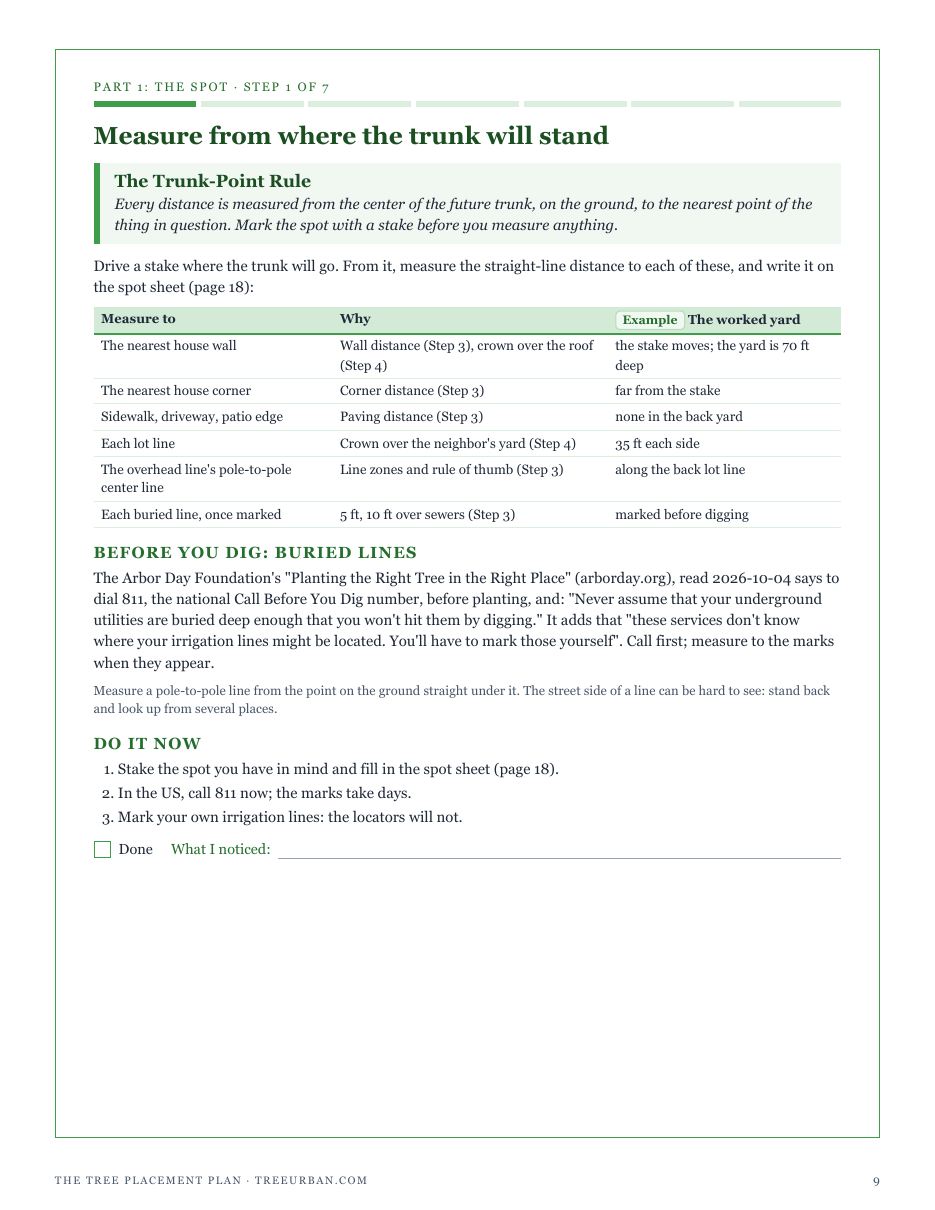
Two full pages from the pack, exactly as printed. Click either to read it at full size before you decide.
What is in it
- The Trunk-Point Rule: every distance measured from where the trunk will stand, and 811 called before you dig
- The Grown-Tree Rule: each candidate's grown spread and grown height, its height class and its grown crown
- The Strictest-Distance Rule: wall, corner, paving, overhead line zones and buried lines, worked on a real yard
- The Half-Spread Rule: keeping the grown crown off the roof and the lot line, and the widest spread a spot holds
- The Count-It-Once Rule: the shade a row really adds once neighboring crowns overlap
- The Donut Rule: a flat planting ring 2 to 4 inches deep, its volume and bags, and when bulk beats bags
- The Two-Crowns Rule: the trees already there, an honest age range and each tree's own yearly pace
- Four printable working pages: spot sheet, candidate fit sheet, ring and mulch sheet, tree log
- A reference table of 20 trees' grown spreads and crowns, and the published distances by grown height
- A quickstart checklist and a personalised sheet worked from your own calculator inputs
- ✓ 24 printable pages
- ✓ 10 sections, worksheets and templates
- ✓ A second PDF worked out from the numbers you enter
- ✓ No account needed, just an email address
- ✓ Instant download; link valid 7 days
Price includes any taxes. Sold by GrabURL, who handle checkout and support. The charge appears on your statement as GrabURL.
The pack picks up where the free Tree Spacing Calculator leaves off. That tool fits grown crowns into an empty rectangle by their spread alone; the published distances from walls, paving and power lines are written by grown height, and it never asks for one. The pack checks a spot against both, with the buried lines 811 marks. With the Tree Canopy Calculator it counts the shade a row really adds once crowns overlap, with the Mulch Calculator it sizes a flat planting ring 2 to 4 inches deep and kept off the trunk, and with the Tree Age Estimator it logs the trees already there, with an honest range on their age. It makes no claim about roots and foundations, and it leaves work near power lines to the utility and pruning, climbing and felling to a certified arborist. Every figure in it is an example for you to replace with your own.